Video shows one of the reasons why Donetsk is running away from new Ukraine. One year ago today Nationalists march through Donetsk, weeks before people of Donetsk decided to separate from new radical regime in Kiev.
Video:


Video shows one of the reasons why Donetsk is running away from new Ukraine. One year ago today Nationalists march through Donetsk, weeks before people of Donetsk decided to separate from new radical regime in Kiev.
Video:
Despite the unceasing flare-ups of separatist violence in the Donbass, Ukraine’s new government has managed to take some steps to move the country forward: it has passed legislation to combat corruption, secured funding to stabilize the economy, and reined in its oligarchs.
But the country’s national parliament, the Supreme Rada, has just taken a much more dangerous step. Lawmakers recently passed a controversial law that honors dozens of nationalist organizations — including far-left socialists, monarchists, and neo-fascists — as “fighters for Ukrainian statehood.” The law states that those who “publicly exhibit a disrespectful attitude” toward these groups, or “deny the legitimacy” of Ukraine’s twentieth century struggle for independence, will be prosecuted (currently no punishment is specified). While most of the groups on the list are harmless enough, among them are two — the Organization of Ukrainian Nationalists (OUN) and the Ukrainian Insurgent Army (UPA) — that were involved in the Holocaust and the ethnic cleansing of Poles in western Ukraine during and after World War II. The inclusion of these organizations among those that are exempt from criticism is deeply disturbing.
The OUN was founded in 1929 as a revolutionary, nationalist organization, designed to throw off Soviet rule and create an independent Ukraine. Much of its leadership had spent time in Nazi Germany, and the group embraced the notion of an ethnically pure Ukrainian nation. OUN literature argued that “Ukrainians are those who are blood of our blood and bone of our bone. Only Ukrainians have the right to Ukrainian lands, Ukrainian names, and Ukrainian ideas.”
While the OUN engaged in partisan warfare against both the Soviet Union and the Germans, it also engaged in the mass ethnic cleansing of Ukrainian Jews, starting with a pogrom in Lviv that killed 5,000 Jews in the summer of 1941. The OUN also infiltrated the Ukrainian Auxiliary Police in German service, collaborating with the Nazi Einsatzgruppen carrying out the Holocaust in Western Ukraine in 1941-1942. After the OUN violently seized control of the Ukrainian Insurgent Army (UPA) — a guerilla group established to support the fight for Ukrainian independence — in 1943, the two groups engaged in another round of ethnic cleansing in western Ukraine, this time directed primarily against Poles.
While the Rada has taken an ill-timed step, Ukrainian
President Petro Poroshenko has not signed the bill yet, and Ukraine’s friends in the West should urge him to veto it.
President Petro Poroshenko has not signed the bill yet, and Ukraine’s friends in the West should urge him to veto it. First and foremost, it is difficult to see how a law making it illegal to criticize groups involved in the Holocaust can be reconciled with Ukraine’s supposedly Western ambitions. Russia’s President Vladimir Putin is widely accused of using his version of history to prop up his rule, and indeed, Moscow has passed a very similar law that criminalizes questioning of the Russian view of World War II. Is this really the model democratic Ukraine wants to follow? It is understandable that Ukraine seeks to break from its Soviet legacy — but the attempt by nationalists to honor the OUN and UPA by encompassing them within the history of Ukraine’s fight for independence is both foolish and wrong.
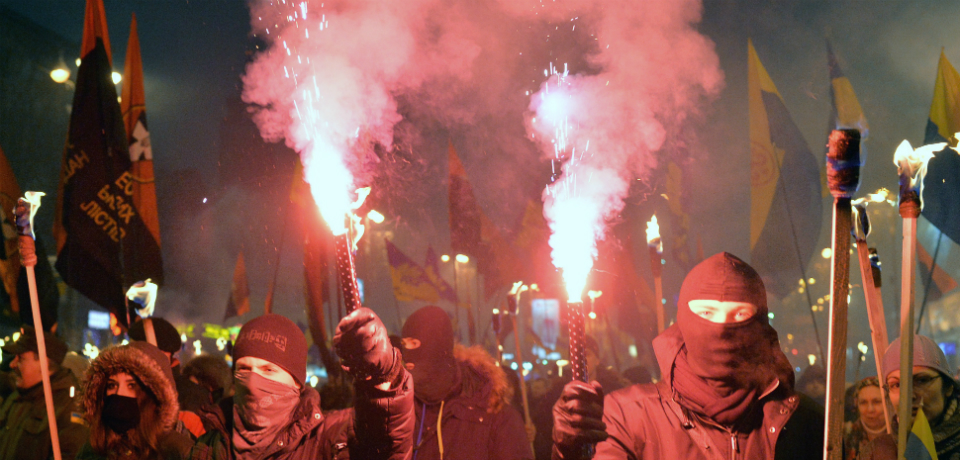
The Rada’s action also risks damaging Ukraine’s international reputation – something the beleaguered country can ill afford. The Simon Wiesenthal Center has already condemned the new law, stating that “to honor local Nazi collaborators and grant them special benefits turns Hitler’s henchmen into heroes.” Ukraine’s allies — particularly Poland — will also have a difficult time accepting this law. Ukraine has been down this road once before. Shortly before leaving office in 2010, former President Yushchenko granted Stepan Bandera, a controversial World War II-era nationalist leader, the status of “Hero of Ukraine,” an action condemned by the European Union and the President of Poland. The Rada should have learned from Yushchenko’s mistake. (In the photo, nationalists hold a torchlight parade in honor of Stepan Bandera in Kiev.)
The law not only offends and discourages Ukraine’s friends — it also helps the country’s enemies. The Rada has, at one stroke, given the Kremlin and its proxies in the Donbass all the ammunition they need to support their longstanding and inaccurate claim that post-revolutionary Ukraine is overrun by fascists and neo-Nazis. Not surprisingly, Kremlin mouthpieces such as RT and Sputnik News have already condemned the law.
Finally, a law that bans criticism of any organizations — particularly ones associated with the Holocaust and ethnic cleansing — raises important free speech issues. It is a clear violation of Ukraine’s constitution, which guarantees everyone “the right to freedom of thought and speech, and to the free expression of his or her views and beliefs.” In addition, as numerous scholars from around the world noted in an open letter to Poroshenko, the law’s adoption would raise serious questions about Ukraine’s commitment to the democratic principles demanded by its membership in the Council of Europe and the OSCE.
To understand why this law was passed despite its obvious negative consequences, it is important to realize that it reflects a broader split in Ukraine along both regional and ideological lines. According to Per-Anders Rudling, a historian specializing in Ukrainian history, what he described as the “OUN-UPA cult” is primarily of western Ukrainian origin, the region where the organizations were most active. “In the east and south, by contrast, the situation is the opposite,” said Rudling. “In Luhansk and Crimea they erected monuments to the victims of the OUN and UPA.”
The law’s defenders are those for whom Bandera and the OUN are heroes of Ukrainian independence who fought heroically against the Red Army well into the 1950s. Its primary drafter, Volodymyr Viatrovych, is a historian at the Institute of National Memory in Kiev who has argued that without Bandera and the OUN-UPA, there would be no independent Ukraine. Viatrovych has been accused by a number of scholars of denying OUN’s involvement in the 1941 pogroms as well as dismissing the collaboration of the Ukrainian Waffen-SS Galizien unit with Nazi Germany as “Soviet propaganda.” The Rada deputy who sponsored the bill is the son of Roman Shukhevych, a politician and military leader who was trained by the Germans and served in a Nazi-supervised auxiliary police unit before becoming head of the OUN-UPA in 1943-1944.
But while the glorification of the OUN-UPA may be most strongly supported by the nationalists, it is troubling that even the Minister of Culture from the pro-European party of Prime Minister Arsenyi Yatseniuk has described the new law as “actually European, really free and unbiased.” Such views by senior government officials represent a historical blind spot about Ukrainian history that, unfortunately, has currency among some Euromaidan activists.
If Kiev hopes to win the battle for hearts and minds among the Russian speakers of eastern Ukraine, embracing the narrative of western Ukrainian nationalists is the wrong way to go about it. “[The two factions’] respective symbols of national identity are mutually exclusive,” argues Nicolai Petro, professor of international politics at the University of Rhode Island, so “imposing one group’s symbols requires eradicating the other’s identity.” How can these two different versions of Ukrainian history be reconciled? “The only way out of this conundrum,” Petro argues, “is by separating national identity from citizenship, and focusing on the promotion of a Ukrainian civic culture.”
Thanks to the Rada’s decision to pass a law honoring organizations associated with the Holocaust, Ukraine is close to scoring an “own goal” – and Ukraine’s friends should encourage President Poroshenko to kick the ball away before it’s too late.
Photo Credit: GENYA SAVILOV/AFP/Getty Images
Source: http://foreignpolicy.com
Children in school #4 in the town of Zhdanovka near Donetsk received school supplies from humanitarian battalion “Novorossia”.
Photos:


Children of war torn Donetsk who suffer from Ukrainian nationalist aggression need help now more than ever. If you would like to help out, you can make a contribution to humanitarian battalion using following credentials:
PayPal: [email protected]
Western Union, MoneyGram:
Receiver: Gubareva Ekaterina Urievna
Ukrainian tank ran over a car that was driven by a bunch of Ukrainian militant nationalists. It is not clear yet if either party was drunk.
Video:
Ukrainian fascists that are fighting on behalf of Kiev regime against Donetsk and Lugansk regions decided to send a message to those who are against their ideology and are trying to separate themselves from Ukrainian nationalists and from Kiev regime that supports radical nationalists.
In the best fascist traditions Ukrainian fighters nailed captured self-defense soldier to a cross and set it on fire.
Video:
Olesya Ovcharenko, officially representing Ukraine, won second place in hand-to-hand combat world championship that was held on April 17-18 in Moscow. However, when it was time to receive medals Olesya came to the stage carrying the flag of Donetsk People’s Republic which is struggling from Ukrainian aggression. When audience saw the flag, everyone began applauding.
In the light of today’s political killings in Ukraine where journalists and politicians that talk against official Kiev regime are being killed, including ten opposition members that supposedly committed suicide, all within days of each other, this brave young girl despite of fear of what might happen to her upon return, showed support for the oppressed Donetsk which coup installed Kiev regime is trying to submit to its rule by force.
Video:
Photos:


The U.S and European Union may want to save Crimeans from themselves. But the Crimeans are happy right where they are.
One year after the annexation of the Ukrainian peninsula in the Black Sea, poll after poll shows that the locals there — be they Ukrainians, ethnic Russians or Tatars are mostly all in agreement: life with Russia is better than life with Ukraine.
Little has changed over the last 12 months. Despite huge efforts on the part of Kiev, Brussels, Washington and the Organization for Security and Cooperation in Europe, the bulk of humanity living on the Black Sea peninsula believe the referendum to secede from Ukraine was legit. At some point, the West will have to recognize Crimea’s right to self rule. Unless we are all to believe that the locals polled by Gallup and GfK were done so with FSB bogey men standing by with guns in their hands.
In June 2014, a Gallup poll with the Broadcasting Board of Governors asked Crimeans if the results in the March 16, 2014 referendum to secede reflected the views of the people. A total of 82.8% of Crimeans said yes. When broken down by ethnicity, 93.6% of ethnic Russians said they believed the vote to secede was legitimate, while 68.4% of Ukrainians felt so. Moreover, when asked if joining Russia will ultimately make life better for them and their family, 73.9% said yes while 5.5% said no.

MOSCOW, RUSSIA – MARCH 18: People attend a concert and rally marking the first anniversary of reunion of Crimea with the Russian Federation on March 18, 2015 in Moscow, Russia. Crimea was annexed by the Russian Federation on March 18, 2014. (Photo by Dmitry Azarov/Kommersant/Getty Images)
In February 2015, a poll by German polling firm GfK revealed that attitudes have not changed. When asked “Do you endorse Russia’s annexation of Crimea?”, a total of 82% of the respondents answered “yes, definitely,” and another 11% answered “yes, for the most part.” Only 2% said they didn’t know, and another 2% said no. Three percent did not specify their position.
With two studies out of the way, both Western-based, it seems without question that the vast majority of Crimeans do not feel they were duped into voting for annexation, and that life with Russia will be better for them and their families than life with Ukraine. A year ago this week, 83% of Crimeans went to the polling stations and almost 97% expressed support for reunification with their former Soviet parent. The majority of people living on the peninsula are ethnic Russians.
The U.S. made a big deal about the rights of ethnic minorities there known as the Tatars, which account for around 10% of the population. Of the 4% total that said they did not endorse Russia’s annexation, the vast majority — 55% — said that they feel that way because they believe it should have been allowed by Kiev in accordance with international law. Another 24% said the referendum vote was “held under pressure”, which means political or military threats to vote and vote in favor.

The GfK survey also asked if the Ukrainian media have given Crimea a fair assessment. Only 1% said that the Ukrainian media “provides entirely truthful information” and only 4% said it was “more often truthful than deceitful.”
For now, the Gallup and GfK polls show a deeply divided Ukraine. The division of political allegiances ultimately threatens Ukraine’s territorial integrity. Only 19% in the east and 26.8% in the southeast think Ukraine should join the European Union, while 84.2% in the west believe Ukraine is a natural fit with the E.U.. Nearly 60% in the north agree that E.U. is the place to be, and just under half in the center part of the country want E.U. integration.
NATO integration is even less supported in the southeast and east, and a little over a third in the center and north agree that Ukraine should join the Western military powers. In the west, that number rises to 53%.
Those numbers also coincide with Ukraine’s trust or distrust with Washington. The pro-integration west, north and center portions of Ukraine all view the U.S. role in the crisis as mostly positive. Well under a third say so in the east and southeast, and almost no one, including the Tatars, believe so in Crimea, GfK poll data suggests.
Interestingly enough, despite Russia’s involvement in the separatist movement in eastern Ukraine, only 35.7% of people polled there said they viewed Russia’s involvement as mostly positive while 71.3% of Crimeans were more in line with Russia’s world view, according to the year old poll from Gallup.
This week, the State Department’s press secretary Jen Psaki said sanctions on Russia will continue until Crimea is returned to Ukraine. Both the State Department and Treasury Department did not clarify whether that was an actual policy statement, nor whether that included the sectoral sanctions which were applied in a third round of sanctions last July following the downing of Malaysian flight MH17 over east Ukraine.
So, Americans came to Ukraine to teach coup installed regime to kill people of Donetsk more efficiently. Here we’ll add photos and videos of training sessions as we get ’em.
Teaching Ukrops to breath properly:

Americans teaching Ukrops on how to shoot a Soviet made RPG, something they should already know!:
Anonymous hacker group ‘CyberBerkut’ was named after SWAT team called Berkut which took the main hit from radical nationalists while trying to protect legitimate government in Kiev during Ukrainian revolution in 2014. CyberBerkut released names of western instructors which were went to Ukraine to teach new regime on how to kill people of Donetsk more efficiently.
Most advisers that are sent to Ukraine of course come from USA.
Released documents:


US military company Academi was earlier known as Blackwater

MOSCOW, April 21. /TASS/. Kiev has moved to the area of the village of Volnovakha 70 mercenaries of the private US military company Academi, the spokesman for the Defense Ministry of the Donetsk People’s Republic, Eduard Basurin, told at a news briefing on Tuesday.
“According to the available information, in the territory controlled by the Ukrainian armed forces, namely, in Volnovakha, the presence of 70 representatives of the private military company Academi has been revealed. Earlier, that company was known under the name of Blackwater,” the Donetsk news agency quotes Basurin as saying.
He recalled that the organization is known for “fulfilling direct orders from the US State Department in hot spots.”
“In 2007, fighters of that private military firm became notorious for shooting 17 civilians in Iraq, among whom were women and children. The event caused a wide response worldwide, after which the organization changed its name. Now the criminal organization is fighting against peaceful Donbass on the side of the Ukrainian authorities,” Basurin said.
The Defense Ministry said the presence of the Academi company in Ukraine, in close proximity to the contact line between the conflicting sides, testifies to violation of Point 10 of the Minsk agreements, which says that illegal armed groups and military equipment as well as fighters and mercenaries should be withdrawn from Ukraine.
In this connection, the DPR authorities are calling on international organizations to join the investigation of the incident.
German media reported last May that data about 400 fighters from Blackwater, supporting Kiev forces in the east of Ukraine came from US intelligence agency.
The White House denied the media reports of US mercenaries hired from private military company Blackwater in eastern Ukraine.
In December, the Academi confirmed its readiness to start training a Ukrainian battalion for street fighting.
Thousands have been killed and hundreds of thousands have been forced to flee Ukraine’s embattled east in clashes between Ukrainian troops and local militias during Kiev’s military operation, conducted since mid-April 2014, to regain control over the breakaway territories, which call themselves the Donetsk and Lugansk People’s republics and constitute parts of the Donetsk and Lugansk regions.
A ceasefire was agreed upon by the parties to the Ukrainian conflict mediated by the Organization for Security and Cooperation in Europe (OSCE) during talks on September 5, 2014 in the Belarusian capital Minsk two days after Russian President Vladimir Putin proposed his plan to settle the situation in the east of Ukraine. The ceasefire has reportedly been numerously violated since.
The Trilateral Contact Group on east Ukrainian settlement comprising representatives of Russia, Ukraine and the OSCE adopted a memorandum on September 19, 2014 in Minsk. The document outlined the parameters for the implementation of commitments on the ceasefire in Ukraine laid down in the 12-point Minsk Protocol of September 5, 2014.
The nine-point memorandum in particular envisioned a ban on the use of all armaments and withdrawal of weapons with the calibers of over 100 millimeters to a distance of 15 kilometers from the contact line from each side. The OSCE was tasked with controlling the implementation of memorandum provisions.
The Contact Group’s meetings in late December 2014 and on January 31, 2015 did not bring major results. Regular talks of the participants of the Trilateral Contact Group were held in Minsk on February 10-12, 2015. Normandy Four leaders also discussed the Ukrainian issue in Minsk then.
A 13-point Package of Measures on implementation of the September 2014 Minsk agreements was adopted at those talks.
The package in particular included an agreement on cessation of fire from February 15, withdrawal of heavy armaments, as well as measures on long-term political settlement of the situation in Ukraine, including enforcement of a special self-rule status for certain districts of the Donetsk and Lugansk regions.
The foreign ministers of the Normandy Four held talks on Ukraine in Berlin on April 13. The focus of the negotiations was implementation of the February 12 Minsk deals (“Minsk-2″).